June 13, 2026 • Diane Bennett • 9 min reading time • Prices verified June 28, 2026
Pre-Workout Label Audit: Which Formulas Hit Clinical Doses and Which Are Padding
Pre-Workout Label Audit: Which Formulas Hit Clinical Doses and Which Are Padding
Walk the supplement aisle — physical or digital — and every pre-workout tub screams the same claims: explosive energy, skin-splitting pumps, unmatched endurance. A pre-workout is a supplement blend you take 20–30 minutes before training, typically combining stimulants, endurance buffers, and blood-flow enhancers to extend performance. The problem is that having an ingredient on the label and having enough of that ingredient to actually do something are two entirely different things. The gap between those two realities is what researchers call a clinical dose — the quantity used in published human trials that produced a measurable performance effect. When a formula falls short of that threshold, the ingredient is essentially decoration. This guide audits the six ingredients that show up most often in pre-workouts, tells you exactly where the clinical cutoffs are, names which products consistently clear the bar, and gives you a decision framework you can apply to any label you pick up.
The Clinical Dose Reference Sheet: What the Research Actually Says
Before you can audit a label, you need the benchmarks. The figures below come from the ISSN’s position stand on pre-exercise nutritional supplements and are corroborated by Examine.com’s ingredient research summaries, both of which aggregate human randomized controlled trial (RCT) data.
By the numbers — minimum clinically effective doses per serving:
| Ingredient | Clinical Minimum | What It Does |
|---|---|---|
| L-Citrulline | 6,000 mg | Nitric oxide production → blood flow / pump |
| Beta-Alanine | 3,200 mg | Carnosine buffering → endurance / fatigue delay |
| Caffeine Anhydrous | 3–6 mg/kg body weight (~200–400 mg for most) | CNS stimulation → focus, power output |
| Betaine Anhydrous | 2,500 mg | Homocysteine management → strength, power |
| Creatine Monohydrate | 3,000–5,000 mg | ATP resynthesis → strength, repeated sprint power |
| Alpha-GPC | 300–600 mg | Acetylcholine synthesis → focus, neuromuscular drive |
One note on citrulline: you’ll see labels list citrulline malate (a compound of citrulline bonded with malic acid) at 6,000–8,000 mg. Citrulline malate is roughly 57% pure citrulline by weight, which means an 8,000 mg malate dose delivers about 4,560 mg actual citrulline — still short of the 6,000 mg standalone citrulline threshold. Per Examine.com’s citrulline malate summary, studies showing meaningful pump and endurance benefits used 6,000–8,000 mg of the malate form specifically, so treat citrulline malate as its own benchmark rather than equating it to straight citrulline gram-for-gram.
How Brands Hide Underdosing: Four Common Tactics
Knowing the numbers is step one. Knowing how brands obscure the gap is step two.
1. The Proprietary Blend
A proprietary blend is a group of ingredients listed as a single total weight — say, “Performance Matrix: 4,500 mg” — without disclosing how much of each ingredient is inside. If that matrix contains citrulline, beta-alanine, betaine, and three other ingredients and the total is 4,500 mg, there is mathematically no way any of the anchor ingredients hits its clinical dose. Proprietary blends are legal under current FDA supplement regulations, but they make third-party auditing impossible and hide the underdosing by design. ConsumerLab.com’s pre-workout supplement review (2025 edition) flagged multiple top-selling SKUs for using proprietary blends that, when reverse-engineered from total weight, could not have included clinical doses of their key actives.
2. Ingredient Splitting
Some brands split a compound across multiple forms to make the label look denser — listing both citrulline and citrulline malate, or creatine monohydrate alongside creatine HCl — without the combined dose clearing the threshold for either form. If you see two creatine variants summing to 2,000 mg total, that’s still an underdosed creatine serving regardless of how many lines it takes up.
3. Fairy-Dusting High-Cachet Ingredients
Alpha-GPC at 50 mg, Huperzine A at 10 mcg, Lion’s Mane at 100 mg — these are ingredients with real research behind them at appropriate doses, included at a fraction of what studies used. The purpose is to allow bold claims on the front panel (“with nootropic support!”) while the actual cognitive-enhancement impact of the dose is nil. Examine.com’s Alpha-GPC research summary puts the effective dose for cognitive and neuromuscular effects at 300–600 mg; a pre-workout tossing in 75 mg is doing marketing, not performance science.
4. Serving Size Manipulation
A label might actually hit clinical doses — but only if you take two scoops. If the serving size listed on the nutrition panel is one scoop and that’s the dose used for all the “per serving” numbers, but the fine print recommends two scoops for “advanced users,” the single-scoop dose is routinely underdosed. Check where the manufacturer’s suggested serving falls relative to the labeled serving.
Formulas That Consistently Clear the Bar (And Why They Do)
Rather than testing products ourselves, the analysis here is grounded in published label data, manufacturer transparency disclosures, and third-party testing certifications. The brands below have made a consistent editorial pattern of full label disclosure and clinical dosing across their flagship pre-workout SKUs.
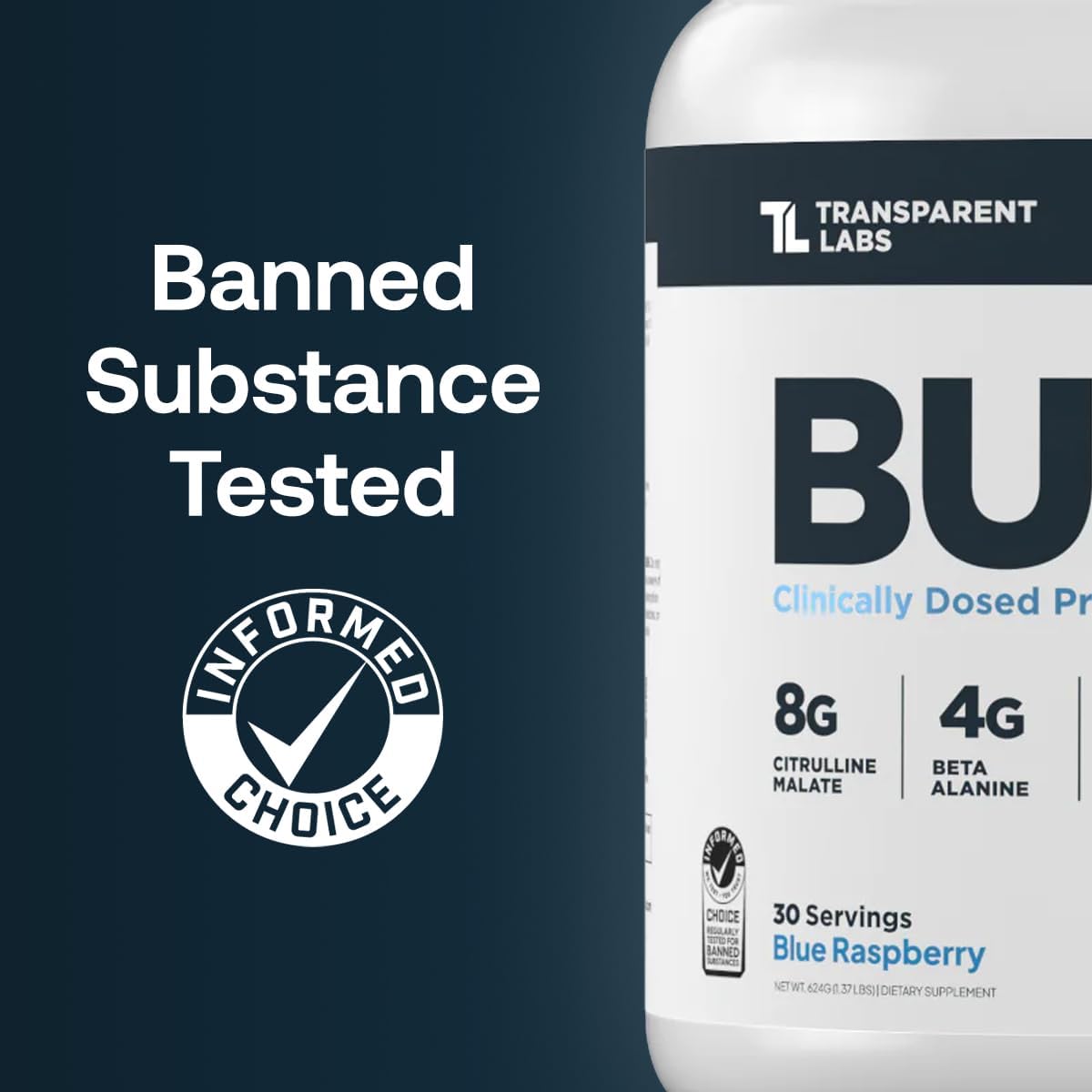
Transparent Labs BULK Pre-Workout is one of the most frequently cited examples in this category because the company publishes full label transparency and has maintained clinical doses in its formula without a proprietary blend. Per published spec sheets and the brand’s own certificate of analysis documentation, a single serving delivers 8,000 mg citrulline malate, 4,000 mg beta-alanine, 300 mg alpha-GPC, and 2,500 mg betaine — clearing the ISSN benchmarks for all four. The caffeine comes in at 200 mg (with a high-stim version at 300 mg), which sits within the evidence-based range for most athletes under the ISSN’s 3–6 mg/kg guidance.
Legion Pulse takes a similar full-disclosure approach. Legion publishes the scientific citations for every dose directly on their product pages, which is a useful accountability mechanism — it makes it easy to cross-reference the supporting research. Their citrulline dose (8,000 mg malate) and beta-alanine dose (3,600 mg) clear the clinical minimums, and the product carries an Informed Sport certification — meaning every batch is tested for banned substances and label accuracy by an accredited third party.
Momentous PR Lotion and Momentous’s pre-workout offering occupy the premium-pharmaceutical tier, with NSF Certified for Sport status that carries arguably the most rigorous testing standard in the consumer supplement space. NSF Certified for Sport requires product testing for 270+ banned substances plus label-claim verification, per NSF International’s program documentation. That certification doesn’t guarantee a clinical dose — it guarantees the label is accurate — so you still do the dose math yourself, but you’re working with numbers you can trust.
Bare Performance Nutrition ENDURE skews more toward endurance athletes but demonstrates the same full-label principle, with 200 mg caffeine, 3,200 mg beta-alanine, and a disclosed electrolyte matrix.
What these products share isn’t a secret formula — it’s a willingness to show you exactly what you’re getting per scoop and price the product to support ingredient quality rather than margin.
The Audit Checklist: A Decision Framework for Any Label You Pick Up
Here’s how to work through a label in under three minutes, in order of importance:
Step 1 — Find the proprietary blend disclosure (or absence of it). If the label groups key actives under a single weight without individual disclosures, stop here and note the red flag. You can still buy it, but you’re accepting that you cannot verify dosing.
Step 2 — Match each anchor ingredient against the clinical minimum table above. Write it down or open the Examine.com ingredient page on your phone. Don’t work from memory on beta-alanine vs. citrulline differences — the numbers matter.
Step 3 — Confirm the serving size the brand actually recommends. Look at the label serving size and the usage instructions. If the directions say “start with one scoop, take two for full effect,” run your numbers on one scoop and call that the audited serving.
Step 4 — Check third-party certification status. NSF Certified for Sport and Informed Sport are the two highest-rigor certifications for athlete use. Labdoor.com publishes independent purity testing on high-volume SKUs and is worth checking for products that don’t carry a certification mark. Certification doesn’t replace the dose audit, but it tells you the label numbers are real.
Step 5 — Run the cost-per-clinical-dose math, not the cost-per-serving math. A $45 tub with 30 underdosed servings costs more per effective workout than a $65 tub with 20 fully dosed servings. Divide the price by the number of servings that actually hit the benchmarks.
If X, Then Y: The Decision Rules
-
If a label uses a proprietary blend for its core actives: Pass, or treat the product as a stimulant-only product and evaluate it only on its caffeine dose. The other ingredients are unverifiable.
-
If citrulline malate is listed below 6,000 mg per serving: The pump/endurance argument for that ingredient doesn’t hold. Fine if pump isn’t a priority, but don’t pay a pump-formula premium.
-
If beta-alanine is between 1,600 mg and 3,199 mg: You’ll get some effect (and the characteristic tingling), but you’re getting half to two-thirds of what the research used. Acceptable in a budget formula; not acceptable at $60+.
-
If the product is NSF Certified for Sport or Informed Sport certified and hits clinical doses on at least three of the six anchor ingredients: That’s a legitimate premium product and the price premium is justified.
-
If you’re a competitive natural athlete subject to drug testing: Third-party certification isn’t optional. The ISSN’s position stand and Informed Sport’s own documentation consistently emphasize that label claims for non-certified products cannot be independently verified for contamination risk. NSF Certified for Sport or Informed Sport, full stop.
-
If you want full clinical doses across all six anchor ingredients in a single scoop: That product will cost $55–$80 retail at 2026 pricing, and it should. The ingredient cost math doesn’t lie. If a product is $30 and claims to deliver 8g citrulline, 4g beta-alanine, 2.5g betaine, 300mg Alpha-GPC, and 200mg caffeine in a single scoop alongside five other ingredients, audit that label with serious skepticism.
The supplement market runs on the asymmetry between what brands know and what buyers check. Closing that gap takes about three minutes per label and the reference table above. Use it every time.