May 24, 2026 • Diane Bennett • 10 min reading time • Prices verified June 28, 2026
Mass Gainers vs. Whey Protein for Bulking: What the Calorie Math Actually Shows

If you’ve ever stood in the supplement aisle — or more likely, scrolled an online cart at midnight — staring at a 12-pound bag of “mass gainer” next to a 5-pound tub of whey protein and wondered which one actually moves the needle on a bulk, you’re asking exactly the right question. A bulk is a deliberate eating phase where you consume more calories than you burn, with the goal of adding muscle while accepting some fat gain along the way. Whey protein is a fast-digesting protein powder derived from milk — it delivers concentrated protein for muscle repair with minimal carbs or fat. A mass gainer is a broader product: whey protein plus a large dose of carbohydrates and sometimes fats, engineered to dramatically raise your total calorie intake in a single shake. Both products can legitimately belong in a well-run supplement program — but they solve different problems, and buying the wrong one is one of the most common and most expensive mistakes intermediate lifters make. This article shows you the actual numbers, names the tradeoffs, and gives you a clear decision rule you can apply today.
The Calorie Math That Most Product Pages Hide From You
Let’s anchor on real numbers before we get into strategy.
Typical single-serving comparison:
| Product Type | Serving Size | Calories | Protein | Carbs | Fat | Est. Cost/Serving |
|---|---|---|---|---|---|---|
| Whey Protein (e.g., ON Gold Standard) | 30g (~1 scoop) | ~120 kcal | 24g | 3g | 1g | ~$0.85–$1.10 |
| Mass Gainer (e.g., Optimum Serious Mass) | 334g (~2 scoops) | ~1,250 kcal | 50g | 252g | 4.5g | ~$3.50–$4.50 |
Retail pricing based on standard 5–12 lb containers, mid-2026.
That cost column is where the conversation usually ends for many buyers — and where it should actually begin. A mass gainer delivers roughly 10–12x the calories of a single whey scoop, but only about 2x the protein. The remaining calories are almost entirely carbohydrates, typically from maltodextrin (a fast-digesting carb derived from starch, often corn or potato) or oat powder. Neither ingredient is inherently harmful — but neither is special, either. You are paying a significant premium for bulk carbohydrate calories you could source far more cheaply from whole food.
Here is the math that exposes the real cost tradeoff: getting 250g of carbohydrates from a mass gainer costs roughly $3.50–$4.50 per serving. Getting 250g of carbohydrates from oats at current grocery prices costs under $0.50. The mass gainer is essentially charging a convenience fee — and that fee compounds quickly over a 12-week bulk.
According to ConsumerLab.com’s 2025 Protein Powder Product Review, label accuracy in the mass gainer category has historically lagged behind whey isolate products, with some products delivering meaningfully fewer grams of protein per serving than the label claims. Labdoor’s 2024–2025 Mass Gainer Rankings and Label Accuracy Reports flagged multiple products for protein spiking — a practice where cheaper amino acids such as glycine or taurine are added to inflate the nitrogen content used to calculate protein on a label, without delivering the muscle-building benefit of complete protein.
This is not true of every brand. Products from companies that submit to third-party testing and publish Certificates of Analysis (COAs) perform substantially better on label accuracy. For verified products, the NSF Certified for Sport program (NSF International) and Informed Sport (LGC Group) maintain publicly searchable certification databases at nsfsport.com and informedsport.com respectively. As a category, however, mass gainers carry more label-accuracy risk than whey protein — and that risk matters when you are budgeting a precision bulk.
How the Three Main Product Tiers Stack Up
Not every buyer is in the same situation. The right choice between a mass gainer and whey protein — and between budget, mid-range, and premium options within each category — depends on your caloric needs, your training phase, and how much margin for error you are willing to accept on label accuracy. Here is how the tiers break down in practice.
Budget Tier: High-Volume Calories at the Lowest Cost Per Serving
Budget mass gainers and entry-level whey proteins occupy the same shelf space but deliver a fundamentally different product. Budget mass gainers from brands such as Optimum Serious Mass and BSN True-Mass are widely available, carry a large calorie payload per serving, and cost less per pound than premium alternatives. The tradeoff is that this tier is where Labdoor’s label accuracy concerns are most concentrated. Budget whey proteins — commodity concentrate blends from regional brands — similarly cut costs by using lower-filtration protein sources that retain more lactose and fat than isolate-based products.
For a lifter whose primary constraint is total calorie intake and whose budget limits options to this tier, a budget mass gainer used once per day alongside whole food meals remains a defensible strategy — provided you verify the product against Labdoor’s ranking list before purchasing and confirm it does not appear on ConsumerLab.com’s flagged-product list.
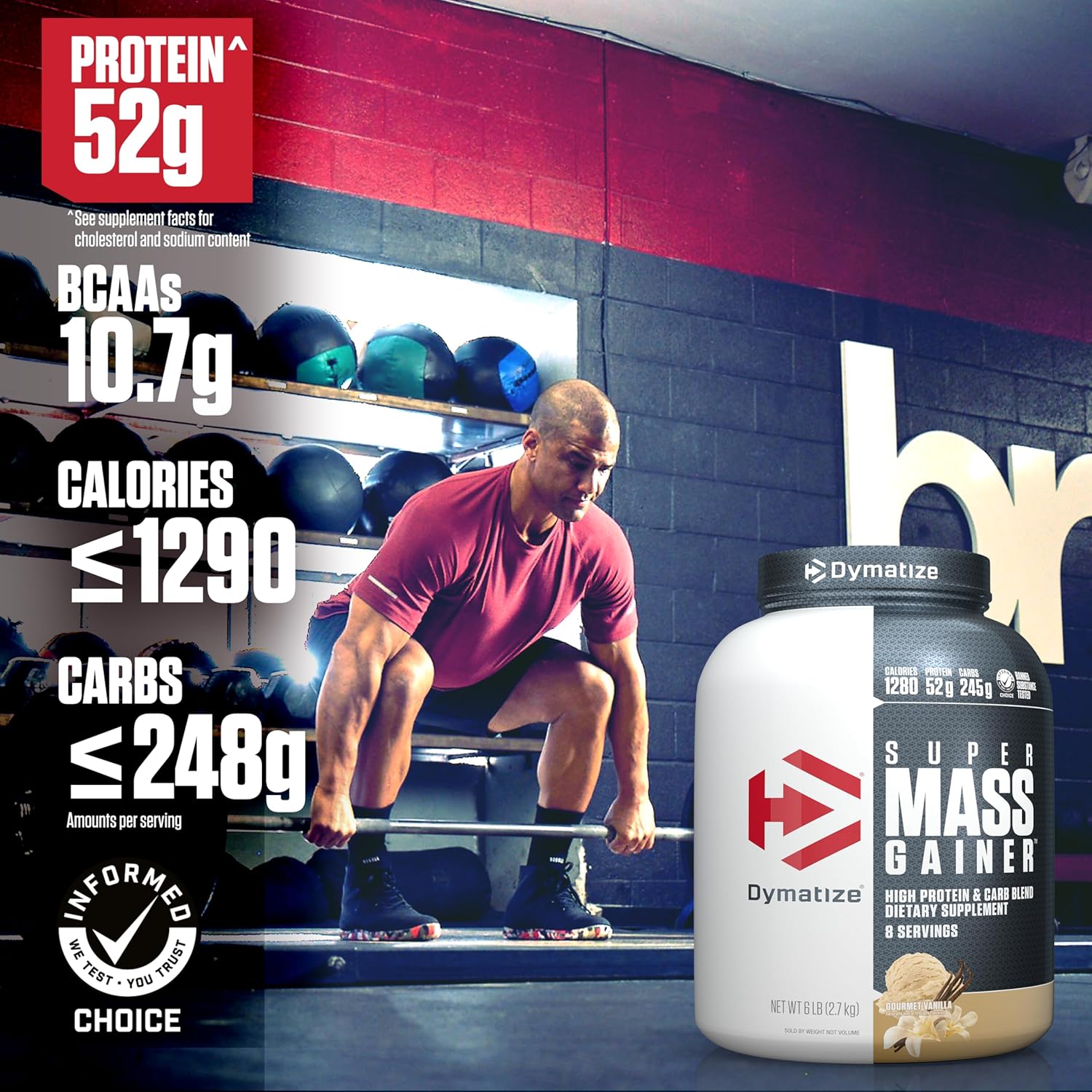
Dymatize
$39.98
In stock on Amazon
Check price on AmazonMid-Tier: Better Label Accuracy, More Flexible Formats
The mid-tier is where the value proposition for whey protein over mass gainers becomes most apparent. Products such as Optimum Nutrition Gold Standard Whey, Dymatize ISO100, and Transparent Labs 100% Whey Protein fall in the $1.00–$1.50 per serving range and consistently earn strong scores on ConsumerLab.com’s label accuracy testing. At this tier, the strategic advantage shifts clearly toward whey protein used alongside self-selected carbohydrate sources — oats, rice, fruit, or a standalone carb powder such as Vitargo or Karbolyn — because the lifter retains full control over the macro split on a day-by-day basis.
The International Society of Sports Nutrition’s Position Stand on Nutrient Timing (Journal of the International Society of Sports Nutrition, 2017) supports the practice of adjusting carbohydrate intake based on training load, a form of macro periodization that is essentially impossible to execute cleanly when your carbs are locked into a fixed ratio inside a mass gainer serving.
Optimum
$44.00
In stock on Amazon
Check price on AmazonPremium Tier: Precision Dosing, Third-Party Verified, Transparent Formulas
At the premium tier, the mass gainer category largely disappears. Brands oriented toward precision supplementation — Momentous, Thorne, Bare Performance Nutrition — do not manufacture traditional mass gainers. Their product philosophy centers on verified, tightly dosed protein with minimal fillers. Premium whey proteins in this tier, such as Momentous Essential Protein and Bare Performance Nutrition Whey Protein, carry NSF Certified for Sport or Informed Sport credentials, publish full COAs, and price accordingly at $1.50–$2.00+ per serving.
For the intermediate-to-advanced lifter managing body composition precisely, the premium tier is the correct reference point for whey protein. The calorie gap is closed with whole food — not with a mass gainer markup. If caloric volume is still a concern at this tier, a separately purchased carbohydrate supplement (oat flour, dextrose, or a dedicated carb powder) maintains the transparency and dosing control that premium buyers are paying for.

Optimum
$81.99
In stock on Amazon
Check price on AmazonWhen a Mass Gainer Actually Earns Its Place
There is a real use case for mass gainers, and it is more specific than most marketing copy suggests.
The International Society of Sports Nutrition’s Position Stand on Protein and Exercise (Journal of the International Society of Sports Nutrition, 2017) establishes that protein synthesis is optimized in the range of 1.6–2.2g of protein per kilogram of bodyweight per day for active lifters. Hitting that target is straightforward with whey protein alone. What is harder for some athletes is hitting total calorie targets — particularly lifters with fast metabolisms, small appetites, or demanding training schedules that leave little time for whole food preparation.
If you are a 185-pound lifter who needs 3,500–4,000 calories per day to gain weight and you are consistently coming in 500–800 calories short despite eating real meals, a mass gainer shake is one of the faster ways to close that gap. Liquid calories sidestep chewing fatigue and gastric fullness — two underrated barriers for hard gainers. In that scenario, the convenience premium becomes justifiable.
The honest use case looks like this:
- You are tracking calories and consistently falling short of your surplus target through whole food alone
- Whole food prep is genuinely time-constrained, not merely inconvenient
- You have verified the product carries NSF Certified for Sport or Informed Sport credentials (searchable at nsfsport.com and informedsport.com)
- You are treating the gainer as a targeted calorie vehicle on specific high-demand days, not as a wholesale replacement for dietary discipline
What a mass gainer is not is a shortcut to muscle that bypasses the protein-and-training equation. Examine.com’s Whey Protein Research Summary (updated 2024) is consistent with the broader research literature in noting that total daily protein intake and training stimulus are the primary drivers of lean mass accrual. The carbohydrates in a mass gainer support glycogen replenishment and training performance — they are not independently anabolic, and in the absence of a sufficient training stimulus, excess calories from any source accumulate predominantly as fat.
The Hidden Variable: Digestive Tolerance
This factor does not appear in calorie math, but it is common enough to warrant explicit discussion.
Mass gainers deliver a large bolus of fast-digesting carbohydrate — usually maltodextrin — in a single serving. For some lifters, this causes significant GI distress: bloating, cramping, and loose stools that can follow a high-maltodextrin shake within 30–60 minutes. GI complaints are among the most consistently cited negatives for mass gainer products across consumer testing platforms, particularly at full serving sizes.
If you have experienced this before, halving the serving size is a common workaround — but it also halves the calorie yield and raises your effective cost per calorie, eroding the main value argument for the product. A whole-food-plus-whey approach is usually better tolerated and more cost-effective once you factor in the reduced usable serving.
For lifters whose GI issues with protein powder relate to lactose rather than carbohydrate volume, whey isolate — which is filtered to remove most residual lactose — is consistently better tolerated than whey concentrate, a distinction highlighted in ConsumerLab.com’s 2025 Protein Powder Product Review. A whey isolate shaken with oat powder and a banana delivers comparable caloric density to a partial mass gainer serving, with substantially better micronutrient complexity and, for most lifters, superior digestive tolerance.
The Decision Rule
Here is a direct framework that maps your situation to the right product choice.
-
If you are consistently hitting your protein target but falling 500+ calories short of your daily surplus goal, and whole food prep is genuinely limited → a third-party-tested mass gainer used as one targeted shake per day is a defensible tool. Verify NSF Certified for Sport or Informed Sport credentials before purchasing. Cross-check label accuracy scores on Labdoor.com’s Mass Gainer Rankings before committing to a brand.
-
If you are not yet consistently hitting your protein target → buy whey protein first. No mass gainer addresses a protein deficit more efficiently than whey, and you will overpay for carbohydrates you do not yet need.
-
If you are an intermediate-to-advanced lifter managing body composition with macro periodization → whey protein plus self-selected carbohydrate sources gives you more control, better economics, and cleaner flexibility across training and rest days. The ISSN’s Position Stand on Nutrient Timing supports carbohydrate cycling based on training load as a meaningful body-composition tool — something a fixed-ratio mass gainer actively works against.
-
If you have experienced GI distress on mass gainers previously → switching brands is unlikely to resolve the issue if the formula is still maltodextrin-dominant. A whey isolate plus whole-food carbs approach is almost universally better tolerated and achieves equivalent or greater caloric density at lower cost once bulk carb sources are priced accurately.
-
If budget is a primary constraint → the math is clear: whey protein is cheaper per gram of protein, and bulk oats or rice covers your carbohydrate calories for a fraction of the mass gainer convenience premium. The supplement industry has a strong financial incentive to sell you the 12-pound bag. The label-accuracy data from ConsumerLab.com and Labdoor.com, and the protein optimization research cited in the ISSN’s position stands, consistently point in the same direction: whey protein is the load-bearing product in a smart bulk. The mass gainer is a niche convenience tool — genuinely useful when the conditions are right, and systematically overpriced when they are not.